Hidrórgano
The Sounds of Empathy
Interactive sound installation / hydraulic instrument
2014
Winner of the 1st prize on the third Kosice Bienale of Art and Technology, 2014.
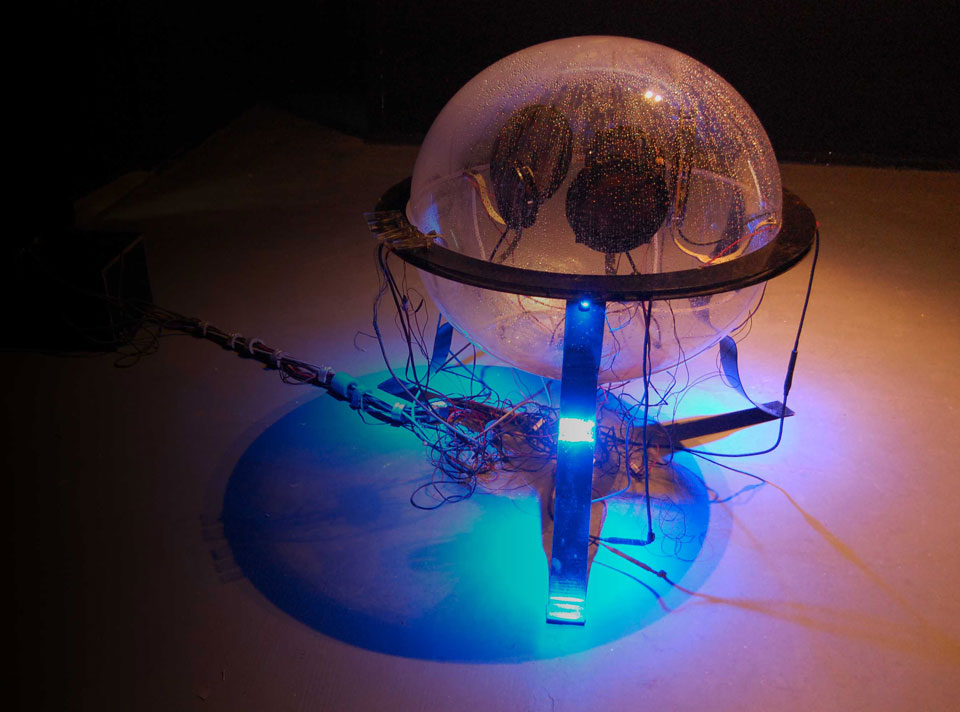
Hidrórgano is an interactive sound installation built as a hydraulic instrument: an acrylic sphere contains a series of tuned bronze plates that are struck by pressurized jets of water. Each impact produces a metallic and aquatic vibration, captured by underwater contact microphones, processed through a sound mixing console, and amplified in the space.
The work begins with a question about musical empathy: what happens when a melody, a rhythm, or a cadence settles into someone’s memory and becomes part of the way they relate to others? Its starting point is not music as a closed composition, but music as a shared phenomenon: something repeated, remembered, hummed, transmitted, and recognized among bodies.
Technically, the system consists of a 0.80 m diameter acrylic sphere, a 1 m³ iron structure, tuned bronze plates whose sizes follow relationships derived from the Fibonacci sequence, acrylic supports, pressurized water motors, custom electronics, Arduino, Raspberry Pi, underwater contact microphones, a sound mixing console, and speakers. The software was custom-developed in C++.
The interaction takes place through the activation of water jets that strike the metal plates. The sound is not digitally generated: it emerges as the physical result of water, metal, pressure, resonance, and amplification. The transparency of the sphere reveals the system in operation, exposing its own mechanism and turning sound production into a visible event.
Hidrórgano also has an autonomous behavior. After three minutes of inactivity, the system activates sound tracks composed specifically for the work by Miguel Rausch. These compositions do not function as background music, but as a way of revealing that the object can behave as an instrument, an installation, and a sound organism: it can be played, it can sound on its own, and it can create a listening situation even when no one is activating it.
The proposed experience is that of approaching a sensitive machine, but not in the sense of an “intelligent” or anthropomorphic machine. Its sensitivity appears in the relationship between repetition, memory, water, and sound. The work invites us to listen to how a technical structure can produce a form of intimacy: a small system of rhythmic tensions and releases that makes the instrument seem melodic, even though its sound material comes from impacts, resonances, and hydraulic pulses.
Within my trajectory, Hidrórgano occupies an important place because it shifts my research on autonomous and interactive systems toward the construction of impossible instruments. The piece brings together several lines that run through my work: the fabrication of technological devices with their own behavior, the relationship between machine and sensory experience, the use of physical phenomena as poetic material, and the question of interaction as a bond rather than a simple technical response.
It was exhibited at the Kosice Biennial / Centro Cultural Borges in 2014, where it received the First Prize of the Third Kosice Biennial of Art and Technology; at the Universidad Nacional de Quilmes in 2015; and at CASo / Casa del Bicentenario in 2017.
Acknowledgments: Martín Guth, Miguel Rausch, and Guillermina Perot Mac Donald.