r-lar
Interactive robotic installation
2022
r-lar is an interactive robotic installation that proposes a videoconference between a person and an android. The work emerged in the context of the COVID-19 pandemic and takes as its starting point an everyday condition of digital communication: the simultaneous presence of the other person’s image and one’s own image on the screen.
The name r-lar comes from robotic-place and dialogues with Marc Augé’s notion of the non-place. The installation constructs a transient space of communication, mediated by cameras, screens, headphones, projection, and robotic behavior; a technical place where identity, presence, and recognition appear in unstable form.
The work offers a critical reading of the way videoconferencing reorganizes attention. In face-to-face conversation, one’s own image is not part of the exchange; in video call platforms, however, one’s face is integrated into the communication device. This image functions as a displaced mirror, as staging, and as a mechanism of self-control in front of the camera.
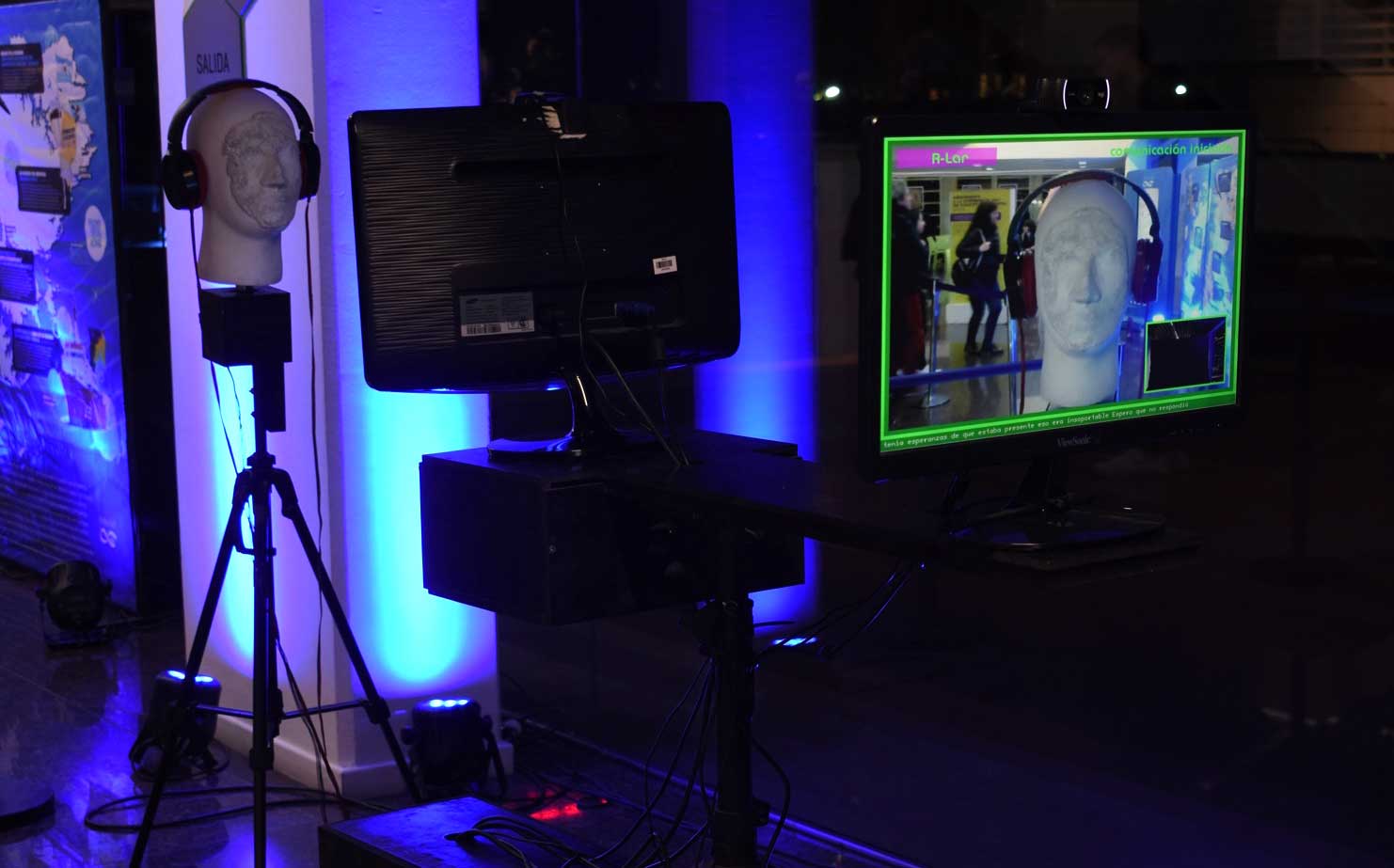
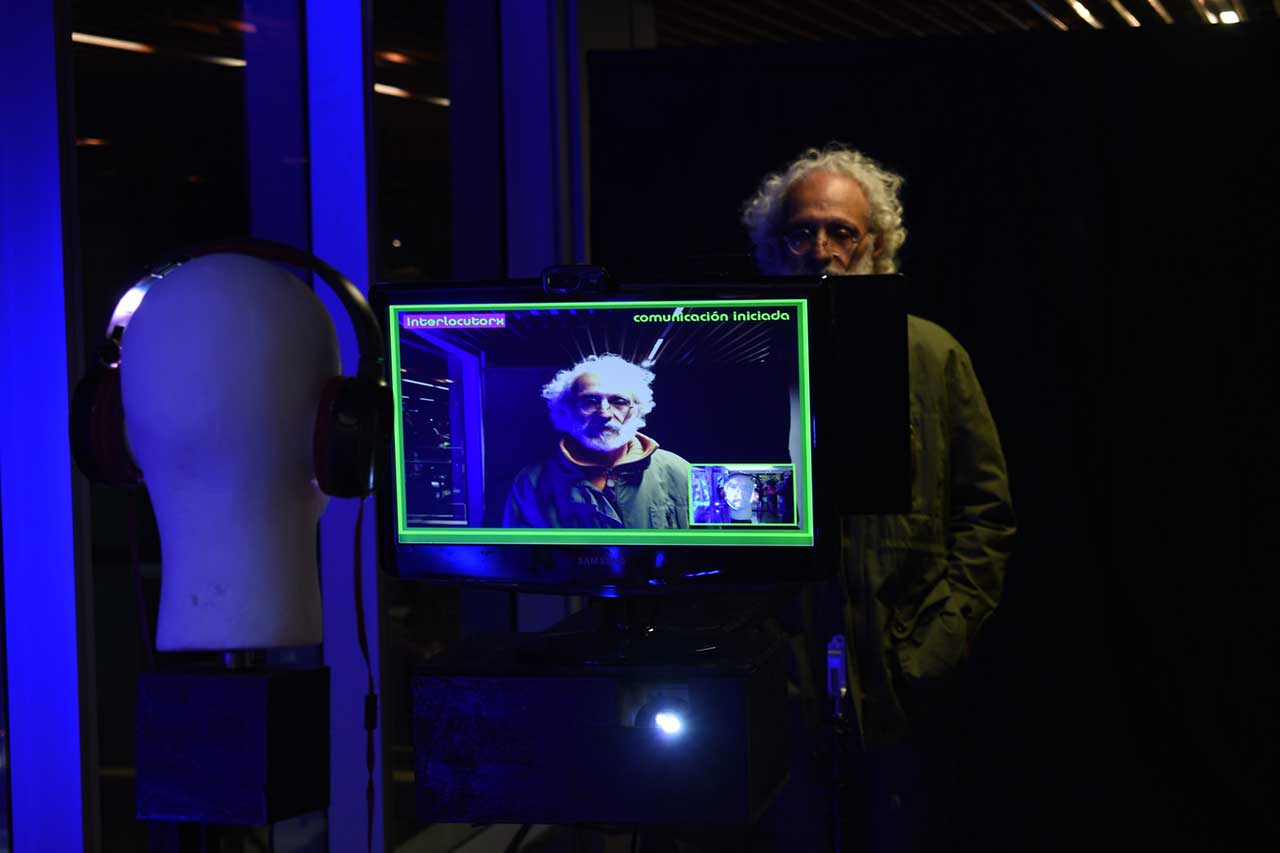
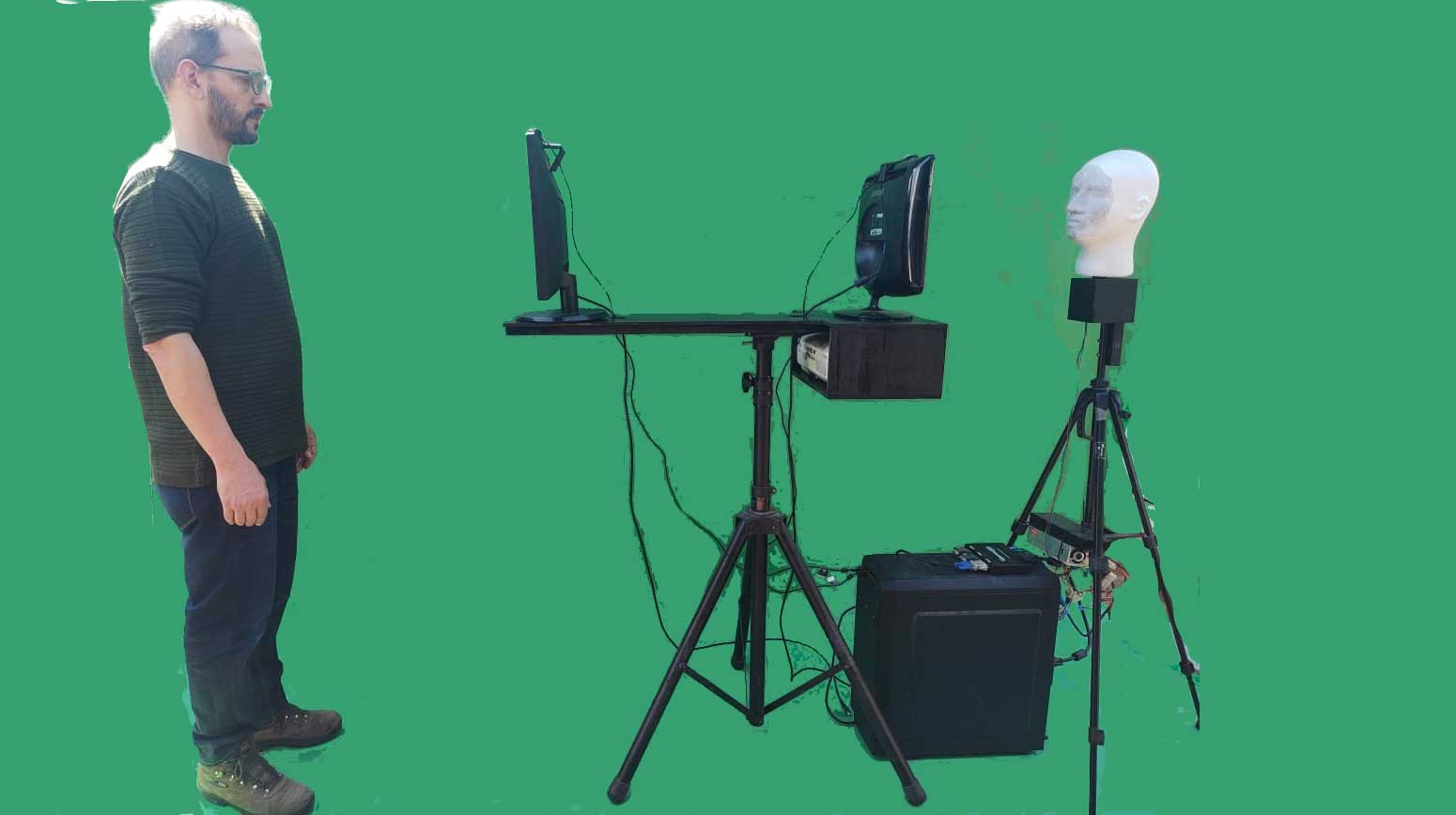
The system is composed of two facing screens. On one side, the person interacts with the installation; on the other, a mannequin head with a papier-mâché mask made by Guillermina Perot Mac Donald is mounted on a stepper motor. One webcam captures the person’s face and movements; another camera captures the android. Each screen reproduces the logic of a videoconference: a main image of the interlocutor and a secondary image from one’s own camera.
Through real-time image analysis, the system detects the rotation of the person’s head and uses that data to move the android’s head. The machine thus replicates the visitor’s gesture, not as a complete expressive imitation, but as a minimal behavior of bodily correspondence. As the interaction unfolds, faces are projected onto the android’s mask, producing a superposition between robotic body, digital image, and human presence.
The installation was developed with low-cost technologies and open-source software: webcams, MediaPipe, Python, Arduino, a DRV8825 driver, stepper motor, video projection, headphones, and image and sound processing. The system also incorporates a spatialized sound dimension: the voice heard by the person is processed to produce an external location, linked to the position of the android, instead of remaining only inside the headphones.
The sound behavior is built from texts generated through natural language processing using two novels: Through the Looking-Glass, and What Alice Found There, by Lewis Carroll, and The Robots of Dawn, by Isaac Asimov. The resulting voice does not seek to sustain a transparent conversation, but rather to produce a fragmentary form of communication, partially recognizable and partially failed.
In this mismatch between image, voice, face, and movement, r-lar situates its central question: what remains of communication when the encounter with the other is organized through interfaces that insistently return an image of oneself?
r-lar belongs to the research project Perceptions and Anticipations in the Art Scene, developed at the Laboratory of Acoustics and Sound Perception (LAPSo) of the Universidad Nacional de Quilmes. It was exhibited at the Universidad Nacional de Quilmes in the context of different activities and at the Centro Cultural de la Ciencia during Museum Night 2022.
The work was produced with a grant from the Fondo Nacional de las Artes.